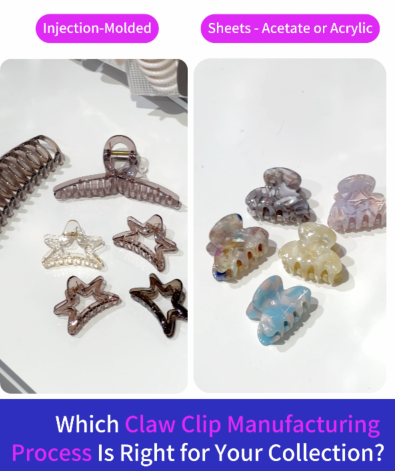
The differences are structural, not cosmetic:
|
Injection molding |
Sheet-cut acetate / acrylic |
|
|
How it's made |
Pellets melted and injected into a steel mold |
Sheet material cut, shaped, and finished |
|
Tooling |
Requires a mold — a new steel mold runs into the thousands of dollars |
No mold needed |
|
Natural, random patterning |
Limited; marble effects achievable, fully organic swirls not |
The point of the process — every piece carries unique flow |
|
Design freedom |
Locked to what the mold allows |
Wide; geometry changes don't require tooling |
|
Per-piece cost |
Lower — this is why volume retail runs on it |
Several times higher |
|
Batch consistency |
Very high across production runs |
Sheet dye lots vary in color and flow — manage at approval, hold through reorders |
|
Small orders |
Practical from existing open molds |
Practical without tooling barriers |
(Sheet-batch consistency cuts both ways: sheet material varies between dye lots, so a sheet-cut program needs tighter color management at approval — and holds that standard through every reorder.)
Injection molding is the backbone of the hair accessory industry for good reasons. Once a mold exists, unit costs drop hard, quality holds across hundreds of thousands of pieces, and cycle times support the monthly volumes large retail programs need — our own lines run 40 injection molding machines for exactly this reason.
Its constraint is the mold itself. A new steel mold costs thousands of dollars, which is why most buyers — including experienced ones — start from a factory's open mold library and customize from there: own colors, own finishes, own packaging. That is what OEM on an existing mold means, and for most private label programs it is the fastest route to market. When a truly custom shape is justified, volumes around 2,000–3,000 pieces per size are where a new mold starts to pay for itself.
The finish ceiling matters too. Injection-molded pieces can achieve a convincing marble effect, and skilled hand-spray finishing can push the look noticeably closer to sheet material's organic flow. But fully natural, random patterning — where no two pieces match — remains sheet territory. If your reference clip has that look, it was almost certainly cut from sheet.
Acetate sheet starts as a material with character: cellulose-based, with depth and flow that read as natural rather than manufactured. Cutting and shaping preserve that character, which is why sheet-cut pieces look different on a shelf long before anyone picks them up.
The process advantages follow directly:
The trade-off is transparent: sheet-cut pieces cost several times more per unit than molded equivalents. That is not a supplier markup — it is a slower, more hands-on process making a materially different product. Buyers whose brand positioning supports premium pricing absorb it easily; buyers competing on shelf price should not be in sheet at all.
If you are holding a reference clip and not sure which world it came from, four checks settle it:
Send the answers with your reference sample and the quotes you get back will be for the same product — not two different ones.
The factories that talk you out of this decision are the ones you should keep. The honest version: neither process is better. Clients choose based on brand positioning and product line, and the strongest collections mix both — molded bodies for volume lines, sheet-cut statement pieces for the premium end.
A simple decision frame:
What breaks programs is not choosing wrong — it is not knowing a choice was made. The buyer who asks for "the same clip, cheaper" without knowing the reference was sheet-cut will receive quotes for a different product, approve a sample that loses the swirl, and discover the gap after the bulk order ships. The distinction costs five minutes to learn. It is the difference between the quotes in your inbox.
One reference photo can hide a five-figure process decision. Injection molding wins on cost and consistency once tooling exists; sheet-cut acetate wins on natural character, design freedom, and tooling-free small runs — at several times the per-piece price. Neither is the "better" process; the right question is which one your reference actually is, and which one your positioning needs.
Send us a reference sample and we will tell you which process it came from before we talk price — explore our OEM/ODM solutions or see how we're different. For how order quantities layer into either process, read MOQ Explained: How Many Units You Really Need for a Private Label Hair Accessories Line.
Q1: Why are acetate hair clips more expensive than injection-molded ones? Sheet-cut acetate runs several times the per-piece price of injection-molded clips because it is a slower, hands-on cutting and finishing process — and unlike molding, that price carries no hidden tooling amortization behind it.
Q2: Can injection molding reproduce the natural swirl of acetate? Not fully. Injection molding can achieve a convincing marble effect, and hand-spray finishing brings it closer, but fully organic, random patterning where every piece differs remains sheet-cut territory.
Q3: Which process works better for small first orders? Sheet-cut acetate works without tooling barriers, so small boutique programs stay viable; molded programs for small orders run from a factory's existing open molds, since a new steel mold costs thousands of dollars and only pays back from roughly 2,000–3,000 pieces per size.
Q4: How do I know which process my reference clip is made with? Check weight (acetate is denser), edges (cut pieces show polished cut edges, molded pieces show parting lines), pattern (identical marbling across units means molded), and the material structure at the jaw tips — or simply send the physical sample to the factory for identification.
Q5: Can a product line mix both processes? Yes, and strong collections usually do: injection-molded bodies for volume lines, sheet-cut statement pieces at the premium end — the choice follows brand positioning and product line, not a single "better" material.